🦴 Once Upon a Time in the Digital Stone Age...
Picture this: it's the mid-1990s, and the internet is like a prehistoric jungle where websites roam wild and free, with no natural predators (yet). Back then, if dinosaurs had websites, they'd probably just put "BIGGEST TEETH IN THE VALLEY" in 72-point Comic Sans and call it SEO!
In those ancient times (aka the '90s), the web was like a massive digital wasteland where finding anything useful required the patience of a Brontosaurus and the determination of a Velociraptor hunting its prey. Yahoo! was the cave painting directory everyone consulted, and getting listed there was like being invited to the coolest mammoth hunt of the season.
The first search engines were basically digital archaeologists, digging through this primordial soup of websites with the sophistication of a caveman with a sharp stick. They counted keywords like counting dinosaur bones – more bones meant a bigger, more impressive dinosaur, right? Well, not quite, but that's what everyone thought!
WebCrawler, AltaVista, and Excite were the T-Rex of their time – big, powerful, but about as subtle as a meteor hitting the Yucatán. These search engines would lumber through the web, chomping on keywords and meta tags like they were prehistoric plants, completely oblivious to what websites actually meant to real humans.

🌋 The Great Keyword Stuffing Extinction Event!
Then came the era we now lovingly call "The Keyword Stuffing Period" – a time when websites looked like they'd been written by caffeinated parrots with a thesaurus. "Best pizza best pizza delicious pizza hot pizza cheap pizza fast pizza delivery pizza!" Sound familiar? That's because everyone was doing it!
Imagine if dinosaurs could talk and they all sounded like broken records: "BIG TEETH BIG TEETH SCARY ROAR BIG TEETH HUNT PREY BIG TEETH!" That's essentially what websites sounded like in the late '90s and early 2000s. It was like the entire internet had developed a severe case of digital Tourette's syndrome.
Back then, SEO "experts" (using air quotes big enough to house a Diplodocus) would tell you to hide keywords in white text on white backgrounds, like digital camouflage. It was the internet equivalent of a Chameleon trying to hide from a T-Rex – clever in theory, but ultimately about as effective as using a flyswatter to stop a charging Triceratops.
Link farms sprouted up like prehistoric ferns after a volcanic eruption. Websites would link to each other in circular patterns that made less sense than a Stegosaurus trying to scratch its own back. "You link to me, I'll link to you, and somehow Google will think we're both the digital equivalent of Jurassic Park's star attractions!"
The funny thing is, this actually worked for a while! Search engines were like baby dinosaurs – cute, but not very smart. They'd see all those keywords and links and think, "Wow, this must be important!" without realizing they were being fed the SEO equivalent of prehistoric junk food.
👑 Enter Google-saurus: The New King of the Digital Jungle!
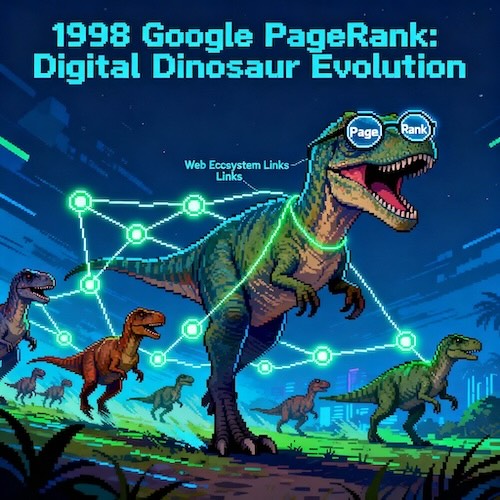
Then, in 1998, two Stanford students named Larry and Sergey discovered something revolutionary – it wasn't about how many times you said "BIG TEETH," but about how many other respected dinosaurs vouched for your big teeth. They called this magical concept "PageRank," and it changed everything!
Google arrived on the scene like a super-evolved Raptor with a PhD in digital archaeology. While other search engines were still counting keywords like counting sheep, Google was analyzing the entire ecosystem. It looked at who was linking to whom, like studying the social dynamics of a dinosaur herd.
Suddenly, the internet went from being a chaotic prehistoric battlefield to something resembling an actual civilized society. Google's algorithm was like having David Attenborough narrating the web – it understood relationships, context, and quality in ways that made the old search engines look like they'd been hit by that famous asteroid.
The old SEO tricks started becoming extinct faster than you could say "Tyrannosaurus" (which, fun fact, means "tyrant lizard king" – kind of like how Google became the king of search). Keyword stuffing went the way of the Dodo, and link farms became as useful as a chocolate teapot in a volcanic eruption.
Website owners suddenly realized they needed to evolve or face digital extinction. The age of "survival of the fittest content" had begun. Darwin would have been proud – the websites that adapted to serve users rather than game search engines were the ones that thrived in this new digital ecosystem.
And just like that, the prehistoric era of SEO came to an end. The internet had evolved from a primitive swamp full of digital dinosaurs to a sophisticated ecosystem where quality, relevance, and user experience ruled the day. The SEO meteor had hit, and only the smart, adaptable websites survived to tell the tale!
🚀 Ready to Fast-Forward Through Time?
The dinosaurs have had their day – now let's see what happened next in the SEO evolution!